Blog

Resume & hiring insights

No-fluff guides on tailoring resumes, beating the ATS, and ranking candidates — straight from the team building Rankid.

The unactionable belief that a graduation year of 1994 caused every rejection, set against what is actually happening, six removable signals on the resume page and three specific fears in the room, all of which can be addressed
Job SearchCareerHiring

Job Searching Over 50: How Age Bias Works and How to Get Past It (2026)

Nobody is rejecting your age. They are rejecting nine proxies for it, and you control almost all of them. Here is the eight-signal audit, the answer to overqualified, and what they legally cannot ask.

Sep 6, 2026 · 25 min read

An internal interview scorecard containing specific job-related scores and a recommendation, set against the forty-one word rejection email the candidate actually received, which contains none of that information and has no reply address
InterviewsHiringCareer

Interview Feedback: Examples, Templates, and How to Ask After a Rejection (2026)

Somebody wrote three specific paragraphs about your interview. You received forty-one words containing none of them. Here is why, how to ask so you actually get an answer, and how to give it without creating legal risk.

Sep 6, 2026 · 24 min read

Two resumes with the same four jobs and the same tenures, one showing the same executive title four times which reads as job hopping, and one where each move adds scope from one channel to a team of four which reads as a career
CareerJob SearchHiring

Job Hopping: How Long to Stay, When It Helps, and How to Explain It (2026)

Nobody counts your jobs. They read the shape of the last six years, and only one of the four shapes causes real trouble. Here is where the line actually is, and how to explain it in forty seconds.

Sep 6, 2026 · 25 min read

Leaving a recruiter message unread produces nothing, no salary datapoint, no read on the market and no contact for later, while spending ninety seconds on a three-line reply produces a real salary number, a read on who is hiring, a named contact for when you need one, and occasionally a better job
CareerJob SearchRecruiting

How to Respond to a Recruiter: Templates for LinkedIn, Email and Every Situation (2026)

A recruiter message is a free option, and ignoring it is the only way to lose. Here are the five questions to ask first, nine templates for every situation, and how to answer the salary question without capping your own offer.

Sep 6, 2026 · 24 min read

A chart showing that what an employer learns about a candidate rises steeply and plateaus at about three hours of assignment length, while the share of good candidates who quietly drop out keeps climbing, with the region past six hours marked as testing free time rather than skill
InterviewsHiringCareer

Take-Home Assignment: How Long It Should Take, Whether to Do It, and How to Win It (2026)

Signal plateaus at about three hours. The cost to you never does. Here is how to tell a fair take-home from free labour, how to spend the hours, and the one section of the README that decides the outcome.

Sep 6, 2026 · 25 min read

A failed informational interview where the candidate does most of the talking about themselves, attaches a resume and asks if the company is hiring, ending in a polite no, set against one that works where the other person does most of the talking about their work and the candidate leaves with a name and a reason to write again
CareerJob SearchInterviews

Informational Interview: Questions to Ask, How to Ask, and Templates (2026)

Most informational interviews fail for one reason: they turn into a pitch. Here is who to ask, the message that gets a reply, the questions worth asking, and the follow-up that actually ends in a referral.

Sep 6, 2026 · 23 min read

A live interview shown as a two-way exchange between a candidate and an interviewer where you can read reactions and recover in real time, set against a one-way video interview shown as a single arrow pointing into a recording light with no reactions, no follow-ups and no chance to clarify
InterviewsCareerHiring

One-Way Video Interview: How to Pass a Pre-Recorded Interview (2026)

No interviewer, no follow-up questions, no way to read the room. A one-way video interview is not a smaller interview, it is a different one. Here is exactly how the format works and how to answer into a camera that never reacts.

Sep 6, 2026 · 24 min read

A one-on-one interview producing a single uncertain score of 72 from one interviewer, set against a panel interview where four interviewers each record an independent score of 68, 74, 70 and 71 that average to 71
InterviewsCareerHiring

Panel Interview: What It Is, How to Prepare, and How to Run One (2026)

A panel interview is not a harder interview. It is a different measuring instrument, and it is usually a good sign. Here is who is in the room, what each seat can veto, and how to answer when four people are watching.

Sep 6, 2026 · 23 min read

Four separation types shown as employment timelines, a furlough drawn as an unbroken line with a dashed unpaid pause before returning to work, and a layoff, a firing for cause and a reduction in force each drawn as a line ending in a cross on the day it happens
CareerWorkplaceHR

Furlough vs Layoff vs Fired: What Each One Means and What You Are Owed (2026)

A furlough pauses the job. A layoff ends it. Being fired ends it differently again. Most people find out which one they are in from a meeting invite, and the difference decides your health cover, your unemployment claim and your notice rights.

Sep 6, 2026 · 24 min read

A week-long calendar showing one worked shift followed by three consecutive no-show days that trigger a typical job abandonment policy, a fourth decision day, and a greyed-out weekend that does not count because policies run on consecutive scheduled work days rather than calendar days
HRWorkplaceCareer

Job Abandonment: How Many Days It Takes, and Whether It Counts as Quitting or Being Fired (2026)

Three missed shifts and no contact. Most handbooks say that is job abandonment. No statute says so, the employer still has to decide what to call it, and that one choice changes unemployment, final pay and how contestable the whole thing is.

Sep 6, 2026 · 23 min read

A salary band from a $96,000 minimum to a $144,000 maximum with a $120,000 midpoint, showing three employees plotted at compa-ratios of 0.82, 1.00 and 1.18, who all earned the same performance rating but received increases of 6.0 percent, 3.5 percent and 1.5 percent respectively
CareerHRWorkplace

Salary Bands and Compa-Ratio: How Companies Actually Decide What to Pay You (2026)

Three people on the same team got the same performance rating this year. Their raises were 6.0%, 3.5% and 1.5%. The number that decided it is one most employees have never been shown.

Sep 6, 2026 · 24 min read

A non-competition clause from an employment agreement with three phrases highlighted, twenty-four months, for any reason, and anywhere in the US, shown alongside three different state outcomes, void entirely in California Minnesota and Oklahoma, enforceable only above a salary line in Colorado Illinois Washington and Oregon, and enforced or rewritten in Florida Texas and Georgia
WorkplaceCareerHR

Non-Compete Agreements: Are They Actually Enforceable, and How to Get Out of One (2026)

The same signed non-compete is worthless in California and enforceable in Florida. Nothing about the document decides that. Here is what really determines whether yours binds you, and what to do if it does.

Sep 6, 2026 · 23 min read

A spectrum showing where quiet firing sits between lawful and unlawful, from ordinary bad management which is legal, through systematic withdrawal of work and access which is usually still legal, to intolerable conditions which may be constructive dismissal, to conduct motivated by a protected characteristic or retaliation which is illegal
WorkplaceCareerHR

Quiet Firing: The Signs, Whether It Is Illegal, and What to Do About It (2026)

Nobody tells you that you are being let go. The projects just stop arriving, the one-on-ones stop being rebooked, and one day you realise you are being pushed toward the door. Here is how to tell, and what you can actually do.

Sep 6, 2026 · 22 min read

How long different kinds of company access survive after an employee leaves, shown as lifetime bars, with the building badge and laptop closed on the last day and email and SSO usually closed within a week, while SaaS tools outside single sign-on and shared service logins stay live past ninety days and undocumented knowledge is gone entirely
HRRecruitingWorkplace

Employee Offboarding: The Process, a Full Checklist, and the Access Nobody Revokes (2026)

The laptop comes back on the last day. The SaaS logins, the shared passwords and everything the person knew mostly do not. Here is the offboarding process that closes all three.

Sep 6, 2026 · 23 min read

The probationary period decoded, a day one to day ninety track with checkpoints at day 30, day 60 and day 90, comparing what almost everyone assumes about probation with what is actually true, that in at-will states day 91 changes nothing and the real changes are benefits and notice
WorkplaceHRCareer

Probation Period at Work: What It Means, the 90-Day Rule, and What Happens If You Fail (2026)

Almost everyone believes passing probation means you cannot be fired. In most of the United States, day 91 changes nothing at all. Here is what a probationary period really does, on both sides of the desk.

Sep 6, 2026 · 22 min read

A separation agreement showing twelve weeks of base salary alongside a full release of all claims, with the three questions that decide whether to sign, whether the number is typical for your level and tenure, what you are giving up in the release, and how long you really have to decide
CareerWorkplaceJob Search

Severance Pay: How Much Is Typical, What You Sign Away, and What You Can Actually Negotiate (2026)

No US federal law requires severance pay. Employers offer it to buy something specific from you, and almost everyone reads the number at the top while skimming the paragraph that decides what the number is actually for.

Sep 6, 2026 · 22 min read

The notice period box on a job application form with three answers compared, immediate which reads as unemployed, a bare three months which gets filtered out, and one month negotiable which is a number plus the one word that keeps you in the process
Job SearchCareerWorkplace

Notice Period: What It Means, What to Write on a Job Application, and How to Shorten It (2026)

It is one small box on the application form, and two of the three things people type into it quietly cost them the interview. Here is what a notice period actually is, what to write, and how much of it you can really shorten.

Sep 6, 2026 · 21 min read

The STAR method for interviews shown as four parts with the seconds each should get in a 90 second answer, Situation 10 seconds, Task 10 seconds, Action 55 seconds and Result 15 seconds, with a note that most candidates spend 60 seconds on Situation and 10 on Action
InterviewsJob SearchCareer

The STAR Method for Interviews: The Time Split, 8 Example Answers, and a Cheat Sheet (2026)

Almost everybody who fails a behavioural interview already knows what STAR stands for. They fail on where the 90 seconds go. Here is the split that decides the answer, one story told twice to prove it, and eight worked examples.

Sep 6, 2026 · 23 min read

The three gates an employee must clear to be exempt from overtime under the FLSA: salary basis, salary level, and the duties test, with duties marked as the hardest and job titles carrying no weight
HiringWorkplaceRecruiting

Exempt vs Non-Exempt Employees: The Three Tests, the Duties Rules, and Why 1099 Is a Different Question (2026)

Salaried does not mean exempt. Exemption requires clearing three separate gates, and the one that decides most cases is not the salary at all. Here is the test, the current thresholds, and the eight patterns that show up in nearly every misclassification claim.

Sep 6, 2026 · 24 min read

The same weekly 30-minute slot run two ways, as a status update where every fact was already in the project tracker, and as a real one-on-one where a genuine problem surfaces
WorkplaceHiringRecruiting

One-on-One Meetings: Agenda Template, Questions, and How Skip-Levels Fit In (2026)

Two managers ran the same 30-minute weekly slot. One spent it confirming facts already in Jira. The other found out a vendor was stonewalling one of their best people, and that it was happening elsewhere too. The difference is structural, not personal.

Sep 6, 2026 · 23 min read

Two versions of the same development plan goal side by side, the vague version that dies within weeks and the specific version naming an assignment, an observable outcome and a date other people are expecting
WorkplaceHiringRecruiting

Individual Development Plan (IDP): Template, Examples, and How to Write One That Survives (2026)

Same person, same goal, same manager. One plan says improve leadership skills, attend training, by end of year. The other names an assignment, an observable outcome and a date two other people already have. Only one of them exists by March.

Sep 6, 2026 · 22 min read

Three named successors on a succession plan reduced to one real successor by three tests: whether anyone has told them, whether they could do the job in 90 days with support, and whether the gap is being closed on purpose
HiringRecruitingWorkplace

Succession Planning: The Process, the 9-Box Talent Review, and a Template That Gets Used (2026)

Three roles, three named successors, all marked ready now. One had already resigned, one had never run a budget, and nobody had told either of them. Here is how to build a succession plan that survives an actual resignation.

Sep 6, 2026 · 24 min read

The same twelve leavers producing three different employee turnover rates depending on whether you divide by starting, ending or average headcount, with average headcount marked as the only comparable option
HiringRecruitingWorkplace

Employee Turnover Rate: The Formula, Benchmarks by Industry, and How to Actually Reduce It (2026)

Twelve people left. Depending on which denominator you pick, that is 10.9%, 12.0% or 13.3%, and almost nobody says which one they used. Here is how to calculate turnover properly, what a good rate looks like in your industry, and which fixes actually move it.

Sep 6, 2026 · 23 min read

The gap between what someone says in an exit interview and what they tell a friend the same week, with the three structural reasons the sanitised version is the one that gets filed
HiringWorkplaceRecruiting

Exit Interviews: 20 Questions That Get Real Answers, a Template, and What to Do With the Data (2026)

Most exit interviews collect a polite fiction and file it. The employee says growth opportunity, tells a friend it was the manager, and nothing changes. Three structural fixes decide whether yours produce anything worth having.

Sep 6, 2026 · 21 min read

The same performance improvement plan read two ways, by the manager who wrote it as a development tool and by the employee who received it as a countdown, with the four tells that reveal which kind it actually is
WorkplaceHiringTemplates

Performance Improvement Plan (PIP): Template, 5 Examples, and What It Actually Signals (2026)

Two people search for this. A manager who has to write one by Friday, and someone who was handed one yesterday and did not sleep. The honest answer to the second question is not the one HR blogs give.

Sep 5, 2026 · 21 min read

A termination letter with the four people who read it later, the employee, an unemployment examiner, an employment lawyer and the next HR person to inherit the file, showing that only one of them is in the room when it is handed over
HiringWorkplaceTemplates

Termination Letter: 6 Templates, What to Include, and What Must Never Go In One (2026)

The person in the room is not the main audience for a termination letter. Three other people read it later: an unemployment examiner, a lawyer, and whoever inherits the file. Write it for them and the meeting gets easier too.

Sep 4, 2026 · 22 min read

The five phases of employee onboarding drawn as a 90-day arc from preboarding through day one, week one, day 30 and day 90, with the two points where new hires quietly disengage marked
HiringOnboardingRecruiting

Employee Onboarding: The Process, a 90-Day Checklist, and the Half That Happens Before Day One (2026)

Most companies think onboarding starts on day one. By then the two things that predict whether someone stays have already been decided: whether their first week has a job in it, and whether you hired the right person at all.

Sep 3, 2026 · 21 min read

An offer letter with the four phrases that quietly turn it into a binding promise highlighted, alongside the safe rewrite of each one
HiringRecruitingOffers

Offer Letter Template: What to Include, 6 Samples, and the Clauses That Cause Trouble (2026)

Most offer letters are fine. The problem is the one in ten that promises something nobody meant to promise: a year of salary, a guaranteed bonus, a permanent job. Here is the template, the six variants, and the exact wording to avoid.

Sep 2, 2026 · 19 min read

A nine-stage hiring process flowchart from requisition approval to onboarding, drawn to scale so that the resume screening stage is far larger than the other eight, showing 19 of the 38 elapsed days sitting in a single stage that produces no record
RecruitingHiringProcess

The Hiring Process: 9 Stages, Who Owns Each, and the One That Eats Your Timeline (2026)

Every guide draws the hiring process as an orderly row of equal boxes. Real processes are not shaped like that. One stage routinely consumes more elapsed time than the other eight combined, and it is the only one that generates no record of having happened.

Sep 1, 2026 · 17 min read

A requisition with 412 applicants owing 411 rejections, showing only 18 sent and 393 left in silence, next to the four candidate tiers ranked by time invested with the response and deadline each one is owed
RecruitingHiringCandidate Experience

Candidate Rejection Email: 7 Templates by Stage and the Sentence That Makes Them Work (2026)

The average rejection email fails for a reason nobody writes about: the recruiter sending it genuinely does not know why the candidate was rejected, because nobody ever evaluated them. You cannot write a specific no about a decision that was never made.

Aug 31, 2026 · 16 min read

Two interviewers reviewing the same candidate reach opposite verdicts, a strong yes based on great communication and a no based on seeming vague, next to a scorecard that resolves the disagreement by rating four weighted criteria from 1 to 4 against written anchors with evidence recorded for each
HiringRecruitingInterviews

Interview Scorecard: Template, Examples, and the Six Parts That Make One Work (2026)

Two interviewers, the same candidate, the same 45 minutes, and opposite verdicts. Neither of them is lying. They were measuring different things, because nobody wrote down what was being measured. That document has a name, and most teams build it at the wrong end of the process.

Aug 30, 2026 · 16 min read

A recruiting dashboard reporting 412 applications received, a 15 percent screen-to-interview rate, a 33 percent interview-to-offer rate and 38 days time to fill, next to the metric it does not report: coverage, showing only 40 of 412 applicants were actually evaluated
RecruitingHiringAnalytics

Recruitment Metrics: The 12 That Diagnose a Broken Funnel (2026)

Your screen-to-interview rate can sit comfortably inside every benchmark while nine in ten applicants were never opened. Most recruiting dashboards cannot see their own biggest failure, because every ratio on them is computed on a denominator nobody chose. Here is the fix.

Aug 29, 2026 · 15 min read

The talent acquisition test: requisition 1 costs $4,560 all in, and after nine hires requisition 10 still costs $4,510 with nothing learned or kept, versus a compounding approach where requisition 10 costs $1,840
RecruitingHiringTalent Acquisition

Talent Acquisition Strategy: Framework, Process, and How It Differs from Recruitment (2026)

There is one test that separates a talent acquisition function from a recruitment queue with a nicer title: does requisition ten cost less than requisition one? If every req starts from a cold job post and an unread pile, nothing is compounding. Here is the framework that fixes that.

Aug 28, 2026 · 15 min read

Internal recruitment reality on one requisition: 406 external applicants and 6 internal applicants in one shared pile, only 2 internal applicants actually read and 1 given a real answer, with a note that a ghosted internal applicant still works at the company
RecruitingHiringTalent Acquisition

Internal Recruitment: Advantages, Disadvantages and How to Screen Internal Candidates (2026)

The cheapest and fastest hire available to you is already on payroll, and on most requisitions they are queued behind 406 strangers in the same inbox. Internal recruitment fails for boring operational reasons, not strategic ones. Here is how to fix it.

Aug 27, 2026 · 15 min read

Diversity hiring funnel for one requisition showing 412 applications received, 372 cut at the resume screen, 34 cut at interview and 5 cut at offer stage, meaning 91 percent of all rejections happen at the resume screen, the stage with the least structure on it
RecruitingHiringDiversity

Diversity Hiring: Inclusive Practices That Change Who Gets Interviewed (2026)

Most diversity hiring budget goes to the top of the funnel, and most diversity outcomes are decided somewhere else entirely. When 412 people apply and 40 get read, the shortlist is chosen by who applied first. Here is how to fix the stage where nine in ten rejections happen.

Aug 26, 2026 · 15 min read

Screening interview breakdown for a shortlist of 14 candidates: 14 screening calls booked, 9 with must-haves verified, 7 with pay expectations aligned and 6 sent to the hiring manager, with the typical 42-minute screen reduced to 15 minutes
RecruitingHiringInterviewing

Screening Interview: 20 Questions and a 15-Minute Structure That Filters (2026)

Most screening interviews run 40 minutes and filter almost nobody, because the recruiter spends them re-reading a resume out loud. A screen has one job: settle the things the resume could not prove. Here is the 15-minute structure and the 20 questions that do it.

Aug 25, 2026 · 14 min read

Recruitment automation breakdown of one requisition: 1.5 hours writing and posting the role, 10.3 hours reading 412 resumes, 2.1 hours scheduling, 6 hours interviewing, with screening the biggest single block at 52 percent and reduced to 20 minutes once automated
RecruitingHiringAutomation

Recruitment Automation: What to Automate, What to Never Automate (2026)

Most recruitment automation advice is a list of fifteen tools. That is the wrong question. The right one is which steps in your hiring process repeat hundreds of times and can be undone if they go wrong, because those are the only steps worth automating, and one of them is eating half your week.

Aug 24, 2026 · 14 min read

Talent pipeline reality check: 412 candidates sourced and saved, 38 ever contacted again, 0 re-screened against a new role, and only 6 usable in practice until one scoring pass returns 14 ranked matches
RecruitingHiringTalent Acquisition

Talent Pipeline: How to Build and Manage One That Actually Fills Roles (2026)

Almost every recruiting team has a talent pool. Almost none of them can use it. The pipeline is not the folder of saved resumes, it is your ability to rank those people against the role that opened this morning. Here is how to build one that survives contact with a real requisition.

Aug 23, 2026 · 13 min read

A Q3 workforce plan showing 12 hires approved, 2 recruiters available, 2,400 applications expected and 60 screening hours implied, against zero screening hours actually planned
RecruitingHiringPlanning

Workforce Planning: The Process, a Template, and the Capacity Nobody Plans (2026)

Workforce plans specify headcount, dates, budget and owners. Almost none of them specify who is going to read the 2,400 applications those hires imply, which is why plans that look fully funded still miss by a quarter.

Aug 22, 2026 · 16 min read

The same role posted two ways: on-site within a 40 mile radius attracting 87 applicants, against the same role posted remote attracting 612 applicants, with one hire either way and all of it to read
RecruitingHiringRemote

How to Hire Remote Employees: The Process, Screening and Pitfalls (2026)

Making a role remote does not widen your funnel, it removes a wall. The commute was quietly the strictest filter you had, and once it is gone the same requisition can pull several times the applications with the same one hire at the end of it.

Aug 21, 2026 · 15 min read

Cost per hire breakdown for one data analyst hire: job board and ads 600 dollars, referral bonus 1,000, checks and tooling 400, interviewer hours 1,350, and recruiter hours 1,210 of which 567 is reading 412 resumes, for a total cost per hire of 4,560 dollars
RecruitingHiringMetrics

Cost per Hire: The Formula, a Worked Example, and How to Cut It (2026)

Every cost per hire calculation adds up the invoices and stops. The larger half is hours already on the payroll, and the single biggest block of those hours is a recruiter reading 412 resumes that mostly should not have needed reading.

Aug 20, 2026 · 15 min read

Adverse impact illustrated: a bachelor's degree requirement produces a 42 percent selection rate for the highest-passing group and 21 percent for a comparison group, giving an impact ratio of 0.50, below the 0.80 four-fifths threshold
RecruitingHiringCompliance

Adverse Impact in Hiring: The Four-Fifths Rule and How to Calculate It (2026)

Adverse impact is what happens when a rule nobody objects to quietly passes one group at half the rate of another. Intent is not the test, which is why it has to be measured, one stage at a time, starting with the screen.

Aug 19, 2026 · 15 min read

Candidate sourcing comparison showing outbound sourcing over one week producing 40 messages, 6 replies and 1 candidate worth interviewing, against 412 applicants already in the ATS of which 300 were never opened and can be scored and ranked in minutes
RecruitingHiringSourcing

Candidate Sourcing: Strategies, Channels and Tools That Fill a Shortlist (2026)

Before you spend a week sourcing 40 new people, count the ones you already have. Most teams buy outbound sourcing to solve a problem that is really an unread pile of 400 applications sitting in their own system.

Aug 18, 2026 · 15 min read

A job requisition form for REQ-2411 marked approved, showing job title Data Analyst Growth, headcount 1 replacement and budget signed off, with the must-have screening criteria field left blank and 412 applications arriving against it
RecruitingHiringATS

Job Requisition: What It Is, the Form, and the Approval Process (2026)

A requisition gets approved with a title, a headcount and a budget, then 412 people apply against it and nobody wrote down what a good candidate looks like. The req is where screening is quietly won or lost, six weeks before anyone notices.

Aug 17, 2026 · 14 min read

Candidate experience timeline showing what an applicant sees: applied on day 0 with an automated confirmation, nothing on day 12, nothing on day 29, and a template rejection on day 41, against the same requisition screened in one pass with every applicant answered inside 5 days
RecruitingHiringCandidate Experience

Candidate Experience: How to Improve It When 400 People Apply (2026)

Nobody sets out to leave 380 applicants in silence. It happens because a careful screen takes 90 seconds, 412 people applied, and the maths does not fit inside anyone's week. Here is how to fix candidate experience at the place it actually breaks.

Aug 16, 2026 · 15 min read

Skills-based hiring: a bachelor's degree requirement struck out and replaced by scored skill evidence, showing Python and ETL pipelines at 92, dbt and warehouse modelling at 78, and Kafka streaming missing
RecruitingHiringATS

Skills-Based Hiring: How to Screen for Skills When 1,200 People Apply (2026)

Everyone agrees you should hire for skills instead of credentials. Almost nobody explains what happens next: you deleted a filter that cost nothing, the applicant pool doubled, and now someone has to actually read for skills. Here is how to do that at volume.

Aug 15, 2026 · 14 min read

Resume parsing explained: a resume PDF converted into structured fields for name, title, experience and education, with the skills field failing to extract because it was laid out in a table
RecruitingATSHiring

Resume Parsing: How It Works and Why Recruiters Lose Good Candidates to It (2026)

Every resume you screen is read by a parser before it is read by a person. When that parser drops a skills section, the candidate does not look broken, they just look weaker. Here is how resume parsing actually works and what it costs you when it fails.

Aug 14, 2026 · 13 min read

High-volume recruiting: a wall of 1,200 applicant tiles for a single req with the top 11 matches highlighted in green, alongside the key ratios of 200 applicants per hire, 40 hours to read by hand and 11 minutes to score the batch
RecruitingHiringATS

High-Volume Recruiting: How to Hire at Scale Without a Bigger Team (2026)

High-volume recruiting does not break because you cannot find candidates. It breaks because 1,200 applications land on one recruiter and screening capacity runs out first. Here is the funnel math, the strategies and the tooling that make hiring at scale survivable.

Aug 13, 2026 · 14 min read

A job offer reduced to a base salary figure alongside the six terms that actually decide whether accepting it was a good decision
Job SearchOffersCareer Growth

How to Respond to a Job Offer: Accept, Decline, or Buy Time (Email Templates, 2026)

The offer arrives and the clock starts. Most people spend those few days deciding whether the number feels big enough, which is the one question the offer already answers. Here is what to check instead, and how to reply.

Aug 12, 2026 · 19 min read

A reference call broken down into the questions actually asked, with would you hire them again highlighted as the question that decides the outcome
Job SearchHiringReferences

Job References: Who to Ask, How to List Them, and What the Reference Check Actually Asks (2026)

Most people pick their references in the ten minutes before the form is due, then treat the call as a formality. Hiring managers say they remove about one in three candidates at this stage. It is the last real gate, and it is the one nobody prepares for.

Aug 11, 2026 · 18 min read

A 30-60-90 day plan shown as a three phase timeline, days 1 to 30 learn, days 31 to 60 contribute, days 61 to 90 own, with what each phase is judged on
InterviewsCareer GrowthNew Job

30-60-90 Day Plan: Template and Examples for the Interview and the Job (2026)

Learn, then contribute, then own. Most plans are three learning phases wearing different labels, which is why they get a polite nod in the interview and are never opened again. Here is how to write one a manager could actually check.

Aug 10, 2026 · 19 min read

Four job listings labelled live, evergreen, ghost and scam, showing how the same job board feed contains four completely different kinds of posting
Job SearchHiringJob Postings

Ghost Jobs: How to Tell If a Job Posting Is Real Before You Apply (2026)

Roughly one in five online job postings is not a job anyone is trying to fill. The damage is not the wasted application, it is that you cannot tell from the outside, so you blame your resume for silence that was never about your resume.

Aug 9, 2026 · 18 min read

The same role written two ways, as a wish list with inflated years of experience and a degree requirement next to a screening spec with five testable must-haves, a published pay band and day-90 outcomes
HiringRecruitingJob Descriptions

How to Write a Job Description That Attracts the Right Candidates (Template, 2026)

Most job descriptions are wish lists written by committee and pasted from the last one. A job description is really a screening spec: every shortlist, scorecard and match score downstream inherits its mistakes. Here is how to write one that filters for you.

Aug 8, 2026 · 19 min read

The same recommendation sentence written three ways, showing how a polite lukewarm line reads as a hedge while a specific line with evidence and comparison reads as a genuine endorsement
HiringCareerWorkplace

Letter of Recommendation Template: Samples for Every Situation (2026)

Almost nobody writes a deliberately bad recommendation letter. They write a polite one, which a trained reader interprets as a hedge. Here is the difference between a letter that helps and one that quietly hurts, with templates for six situations.

Aug 7, 2026 · 20 min read

An employment verification letter and the four requesters who ask for one, a mortgage lender, a landlord, a new employer and a visa application, each of which needs different information included before the letter will be accepted
HiringJob SearchWorkplace

Employment Verification Letter: Templates and What to Include (2026)

Most employment verification letters get rejected for the same reason: they were written for the wrong requester. A mortgage lender, a landlord and a consulate all want different things. Here are the templates, plus what employers must never include.

Aug 6, 2026 · 18 min read

How to write a performance review self-evaluation: recover the year from artifacts rather than memory, convert each item into a claim with evidence and impact, and write it so your manager can lift lines straight into the review they file
CareerPerformanceWorkplace

Self-Evaluation Examples for Your Performance Review (2026)

The form says summarise your contributions this year and you cannot remember March. Lists of 80 generic phrases do not help, because none of them are about your work. Here is how to reconstruct the year from evidence, and what a self-review is really for.

Aug 5, 2026 · 19 min read

How long a pre-employment background check takes: most complete in two to five business days, with the delays concentrated in county court records, education verification and international history rather than in anything the candidate did
Job SearchHiringCareer

How Long Does a Background Check Take? Timelines by Check Type (2026)

Most background checks finish in two to five business days. The ones that do not are almost never about you: they are stuck in a county courthouse, a registrar's office or a former employer's HR queue. Here is the timeline by check type, and what to do when day ten arrives with no news.

Aug 4, 2026 · 17 min read

A day-by-day job interview preparation plan showing what to do five days before, two days before, the night before, the morning of, and the ten minutes before an interview, next to the four things preparation actually has to produce
InterviewsJob SearchCareer

How to Prepare for a Job Interview: A Day-by-Day Plan (2026)

Most people prepare for an interview by rereading the job posting and googling questions at 11pm the night before. Preparation is not a memory task, it is a logistics task with a deadline. Here is the plan, spread across the week, with the night-before and morning-of checklists.

Aug 3, 2026 · 18 min read

A comparison of what an unstructured interview measures, namely how much the candidate reminds you of yourself and who interviews well, against what the same questions measure when asked consistently and scored, namely evidence they have done the work and a decision you can defend afterwards
HiringRecruitingInterviews

Interview Questions to Ask Candidates: 40 That Predict Performance

Most hiring managers walk in with a list of questions and no way to compare the answers, which is why interviews so often pick the most confident candidate rather than the best one. Here are 40 questions grouped by what they actually measure, and the scoring structure that makes them worth asking.

Jul 31, 2026 · 18 min read

Interview preparation reduced from 60 questions to memorise down to the five things employers are actually asking: can you do the job, will you actually do it, will we mind working with you, why us and not anywhere else, and what is the risk in hiring you
InterviewsJob SearchCareer

How to Answer Interview Questions: 12 Answers, One Method

Every guide hands you 60 questions to memorise, which is why almost nobody prepares properly. There are really only five questions, and the 60 are rewordings of them. Learn the five, bank six stories, and you can answer anything they ask.

Jul 31, 2026 · 19 min read

A four step dress code ladder from casual to business professional showing the one rule for interview attire: find what the team wears on an ordinary Tuesday, which here is smart casual, then step up exactly one level to business casual, because two levels up reads as a costume
InterviewsJob SearchCareer

What to Wear to an Interview: Every Dress Code, Decoded

There is no universal interview outfit, which is why every generic list of rules eventually contradicts itself. There is one rule: find out what the team wears on an ordinary Tuesday, then dress exactly one level above it. Here is how to find that out, and what to physically put on once you know.

Jul 31, 2026 · 16 min read

A calendar year showing why timing decides a raise: asking at the March performance review returns 3% because the budget pot was divided in January, while asking in September before planning season returns 11% because your manager had a number and a case to argue for
CareerJob SearchOffers

How to Ask for a Raise: Timing, Scripts and How Much to Ask For

Most people ask for a raise at their performance review, which is the single worst moment of the year to do it. The money was divided months earlier, in a planning meeting you were not invited to. Here is when to actually ask, how much to ask for, and the exact words to use.

Jul 31, 2026 · 16 min read

Salary negotiation in three steps: they offer $95,000 which is almost never the top of the band they approved, you counter with a single number of $112,000 backed by market data, and you settle at $104,000, which is $9,000 a year that compounds on every raise and bonus afterwards
Job SearchCareerOffers

How to Negotiate Salary: Scripts, Emails and What to Counter

The offer you were given is a position inside an approved band, not the edge of one. Most candidates accept the first number because they are afraid of an outcome that almost never happens. Here is how much to counter, the exact words for each moment, and the eight things still on the table when base pay will not move.

Jul 31, 2026 · 17 min read

Two thank you emails after an interview compared side by side: the generic version thanking them for their time and saying you look forward to hearing back adds no evidence and changes nothing, while the version referencing the day-30 onboarding drop-off they described and the retention numbers you moved gives the interviewer something to repeat in the debrief
InterviewsJob SearchCareer

Thank You Email After an Interview: 9 Templates and When to Send

Almost every candidate sends the same four polite lines, and those four lines change nothing. The thank you email is the last piece of evidence you get to file before a hiring decision, and one paragraph in it does all the work. Here is what to send, when, and nine templates for every kind of interview.

Jul 31, 2026 · 15 min read

Questions to ask in an interview ranked in three tiers: asking what the company does is answerable from the homepage and costs you credibility, asking what a typical day looks like is safe but forgettable, and asking what this person needs to have done in 90 days for you to be glad makes the interviewer picture you in the job
InterviewsJob SearchCareer

Questions to Ask in an Interview: 40 Smart Ones for Every Round

Every guide hands you a list of 60 questions and leaves you to work out which two to use. The right question depends entirely on who is sitting opposite you: a recruiter cannot tell you how success is measured, and a hiring manager does not want to discuss the process timeline. Here are 40 questions sorted by round and interviewer, the five that quietly screen the employer, and the one closing question almost nobody asks.

Jul 30, 2026 · 16 min read

How to write a resignation letter: a short five line letter template stating the resignation, job title, last working day, an offer to help hand over and one line of thanks, beside a checklist of the five elements every resignation letter needs
Job SearchTemplatesCareer

How to Write a Resignation Letter: 7 Templates for Every Situation

A resignation letter has one job, and it is not to explain yourself. Five lines cover it: that you are resigning, your title, your last day, an offer to hand over, and one line of thanks. Here are seven templates you can copy for every situation, the five things that must never go in the letter because it lives in your personnel file forever, and the sequence that matters more than the wording.

Jul 30, 2026 · 17 min read

Reason for leaving a job, good answers compared: a bad version blaming an impossible manager and a chaotic company reads as risk, while a good version saying you had learned what you could and wanted to own reporting end to end reads as direction, using the same facts pointed forward
Job SearchApplicationsInterviews

Reason for Leaving a Job: Good Answers for Applications and Interviews

Most advice on this question gives you a list of acceptable reasons and stops there, which is no help when you are staring at a one-line box on an application form or being asked out loud by your future boss. Those are two different answers, and a third version is on file at your old employer. Here is what to write, what to say, and how to reframe the situations nobody wants to explain, without lying about any of it.

Jul 30, 2026 · 16 min read

CV vs resume comparison table: a CV runs 2 to 10 or more pages with your whole record and is standard in the UK, Europe and academia, while a resume is a 1 to 2 page document containing only what fits the job and is the default in the US and Canada
Resume TipsJob SearchResume Writing

CV vs Resume: The Real Difference and Which One to Send (2026)

Most guides tell you a CV is long and a resume is short, which is true in exactly one part of the world. In the UK, Europe, India, Nigeria and Australia, a CV is just what they call a resume. Here is the difference that actually matters, region by region, plus the five fields normal on a European CV that must come off before you apply in the US, and the one case where the two documents genuinely are different things.

Jul 30, 2026 · 15 min read

How far back should a resume go: a career timeline split into three zones, the last 10 years kept in full detail with bullets and keywords, 10 to 15 years ago condensed to title, company and dates, and anything older than 15 years grouped into one Earlier Experience line or cut
Resume TipsResume WritingJob Search

How Far Back Should a Resume Go? Work History Rules for 2026

Ten to fifteen years is the answer you will read everywhere, and it is roughly right, but nobody tells you what to do with the twelve years sitting behind it. Here is how to set your own cut line by career stage, how many jobs to actually list, how to group older roles so your timeline keeps no holes in it, and the one test that overrules the rule entirely.

Jul 30, 2026 · 14 min read

Applicant tracking systems list: one resume feeds into twelve platform tiles including Workday, Taleo, iCIMS, SuccessFactors, Greenhouse, Lever, Ashby, Workable, SmartRecruiters, UKG UltiPro, Paycom and Paylocity, each of which screens that same resume in a different way
ATSJob SearchApplications

Applicant Tracking Systems List: What Workday, Greenhouse, Taleo and iCIMS Do With Your Resume (2026)

Every job seeker is told to write an ATS-friendly resume, as if there were one ATS. There are dozens, and they behave very differently: Taleo parses strictly, Greenhouse barely parses at all, Workday can grade you with AI, and payroll suites like UKG and Paycom ignore your resume in favour of a form. Here is the list of systems you will actually meet, how to identify each one from the apply URL before you spend twenty minutes on it, and what to change for each.

Jul 29, 2026 · 18 min read

How to get found by recruiters on LinkedIn: a recruiter search for data analyst AND SQL OR Python AND Power BI AND London ranks profiles that contain all four terms first, while a profile headlined results-driven professional passionate about growth matches zero terms and never appears
LinkedInJob SearchCareer Advice

How to Get Found by Recruiters on LinkedIn (Keywords, Headline Examples, 2026)

Recruiters do not scroll LinkedIn looking for talent. They type a job title, a few tools, and a location into a search box, then contact people on page one. If your profile does not contain the words they type, you are not competing badly, you are not in the result set at all. Here is exactly how LinkedIn recruiter search works, which fields count, and how to rewrite your headline, About section, skills, and experience so the right searches find you.

Jul 28, 2026 · 17 min read

How to write a cover letter for a job application: keep it to 250 to 400 words on one page, 3 to 4 paragraphs of proof with zero filler, and write it for one posting in that posting's own words
Cover LettersJob SearchCareer Advice

How to Write a Cover Letter for a Job Application (Format, Length, Examples, 2026)

Most cover letters get skimmed in twenty seconds, and almost all of them waste the first sentence. This guide shows you how to write a cover letter for a job application that a hiring manager actually finishes: the 5-part format, the right length, how to start and end it, how to address it when there is no name, and short examples for experienced candidates, career changers, and people with no experience yet.

Jul 27, 2026 · 16 min read

How to quantify achievements on a resume: four kinds of numbers to look for, how many (scale), by how much (growth), worth what (money), and how fast or often (time)
Resume TipsJob SearchCareer Advice

How to Quantify Achievements on a Resume (Examples, Even With No Numbers, 2026)

"Increased sales" says nothing. "Grew sales 42% in two quarters" gets an interview. This guide shows you how to quantify achievements on a resume, including how to find numbers when you never tracked any: the four kinds of metrics hiding in every job, a three-question method to estimate them honestly, and quantified bullet examples for sales, support, engineering, marketing, and roles that feel unmeasurable.

Jul 23, 2026 · 14 min read

How to write a career change resume: a current role as a classroom teacher connected by a bridge of transferable skills to a target role as an L&D specialist, matched to the job posting
Resume TipsJob SearchCareer Change

How to Write a Career Change Resume (Examples + Template, 2026)

Changing careers does not mean starting from zero. It means proving that what you already do transfers. This guide shows you how to write a career change resume step by step: the best format, a career change resume summary formula with examples, how to translate your old-field experience into the new role's language, and how to make it pass the ATS so a recruiter actually reads it.

Jul 22, 2026 · 15 min read

How to write a resume with no experience: a blank before resume with no jobs to list, transformed into an after resume with a summary, education, projects, skills, and quantified transferable wins
Resume TipsJob SearchStudents & Grads

How to Write a Resume With No Experience (Step by Step, 2026)

Every first job wants experience, and you cannot get experience without a first job. Here is how to break that loop: a step-by-step guide to writing a resume with no experience, including what to put on it when your work history is blank, how to turn coursework, projects, and volunteering into proof of skill, and how to make it pass the ATS.

Jul 21, 2026 · 14 min read

PDF vs Word resume comparison: a .pdf that locks your layout and is fine for modern ATS, versus a .docx that is easiest to parse and safest for older applicant tracking systems
Resume TipsATSJob Search

PDF vs Word Resume: Which File Format Is Best for ATS in 2026?

PDF or Word? It is one of the most searched resume questions, and most advice gets it half right. Here is the straight answer on the best resume file format for ATS in 2026: when to send a PDF, when to send a .docx, the format mistake that quietly gets resumes rejected, and how to confirm your file actually parses.

Jul 20, 2026 · 12 min read

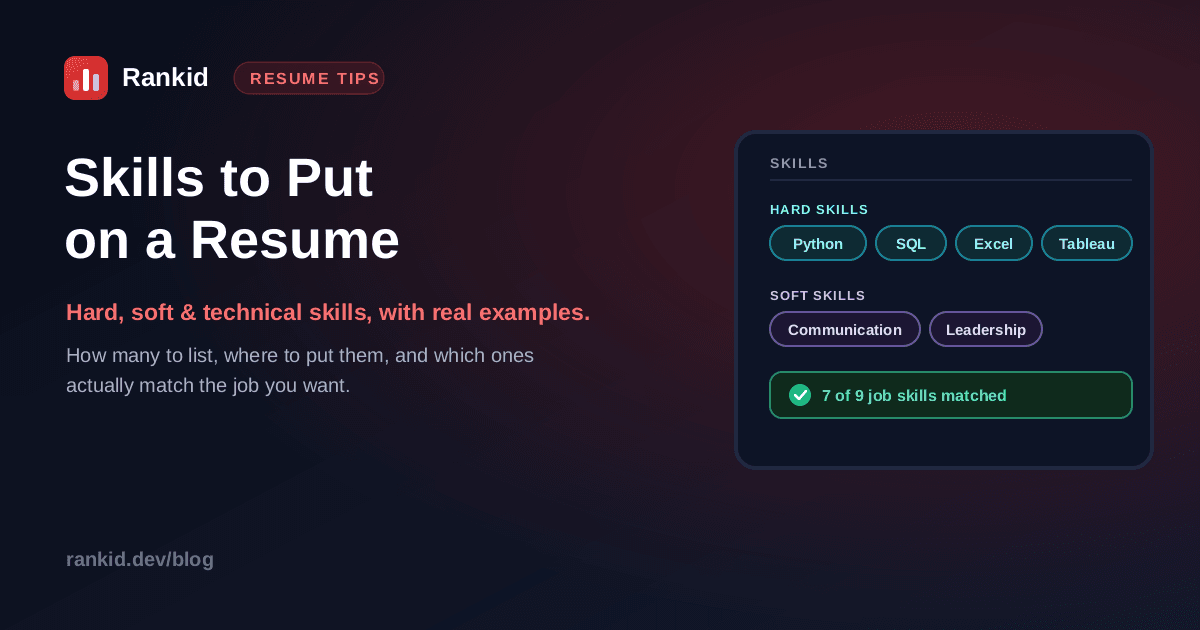
Skills to put on a resume: a skills section listing hard skills like Python, SQL, Excel and Tableau plus soft skills like communication and leadership, with 7 of 9 job skills matched
Resume TipsJob SearchCareer Advice

Skills to Put on a Resume: Examples for 2026 (Hard, Soft & Technical)

A generic skills list will not get you shortlisted. This is the complete guide to the skills to put on a resume: hard, soft, and technical skills with examples by field, how many to list and where, the exact way to prove each one, and how to pick the skills the job is actually searching for.

Jul 18, 2026 · 14 min read

Resume action verbs: replacing the weak phrase 'responsible for a team' with the strong verb 'Led a team of 8', because a strong verb plus a number makes a bullet that ranks
Resume TipsJob SearchCareer Advice

Resume Action Verbs: 200+ Power Words to Get Noticed (2026)

Weak verbs quietly sink strong resumes. This is the master list of resume action verbs, 200+ power words sorted by what you actually did, plus the tired phrases to delete, the exact formula that turns a duty into an achievement, and why the right verbs help you match the job and get read.

Jul 17, 2026 · 13 min read

How to explain employment gaps on your resume: a work history timeline with a career break reframed, not hidden, and the note that a gap does not fail the ATS
Resume TipsJob SearchCareer Advice

How to Explain Employment Gaps on Your Resume (2026 Examples)

A gap in your work history feels like a red flag, but it is one of the most common and most survivable things on a resume. Here is how to explain employment gaps honestly, with word-for-word examples for a layoff, caregiving, health, study, and a sabbatical, how to format the dates so a short gap disappears, and why the ATS never rejects you for the gap itself.

Jul 16, 2026 · 12 min read

How long should a resume be: ideal resume length by experience, one to two pages for most candidates and what the ATS prefers
Resume TipsResume WritingJob Search

How Long Should a Resume Be in 2026? (Ideal Length by Experience)

One page or two? It is the most argued-about question in job hunting, and most advice gives you a rule without the reason. Here is the ideal resume length by experience level, when a second page is justified, exactly what to cut first, and why recruiters and the ATS care about relevance and keyword match far more than they care about page count.

Jul 15, 2026 · 11 min read
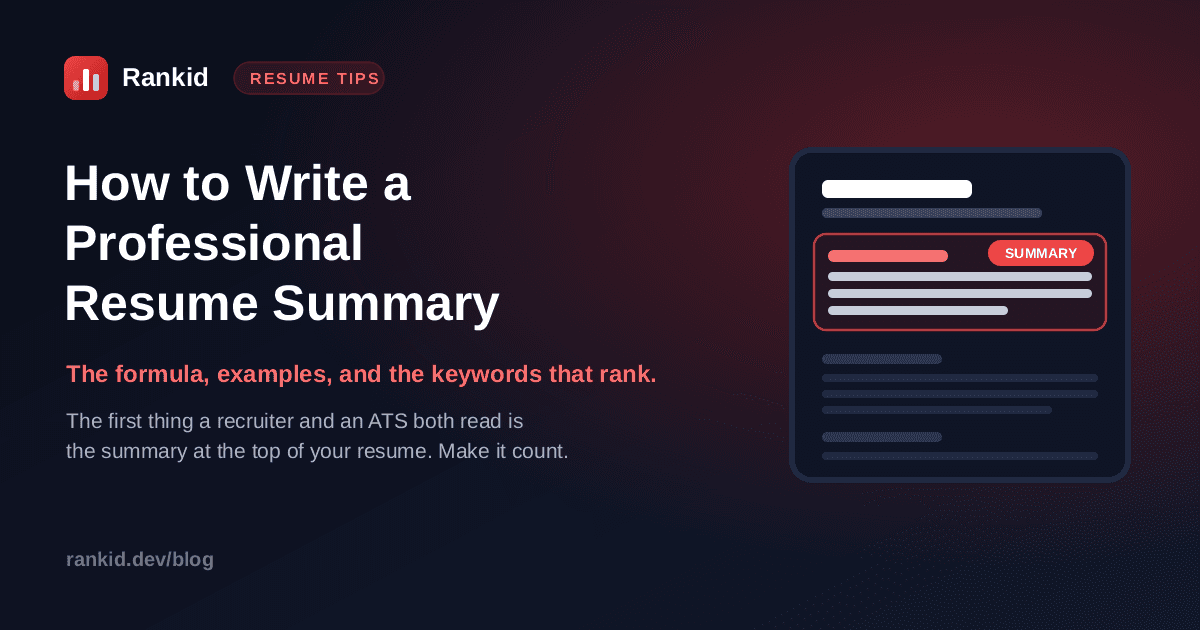
How to write a professional resume summary: a four-part formula of title, years, top skills, and a signature achievement
Resume TipsJob SearchResume Writing

How to Write a Professional Resume Summary (2026 Examples + Formula)

The first thing a recruiter and an ATS both read is the summary at the top of your resume. Get it right and you set the tone in six seconds; get it wrong and the rest barely gets read. Here is a proven formula, resume summary examples for every situation, and how to load it with the right keywords so you rank higher against the job.

Jul 14, 2026 · 12 min read
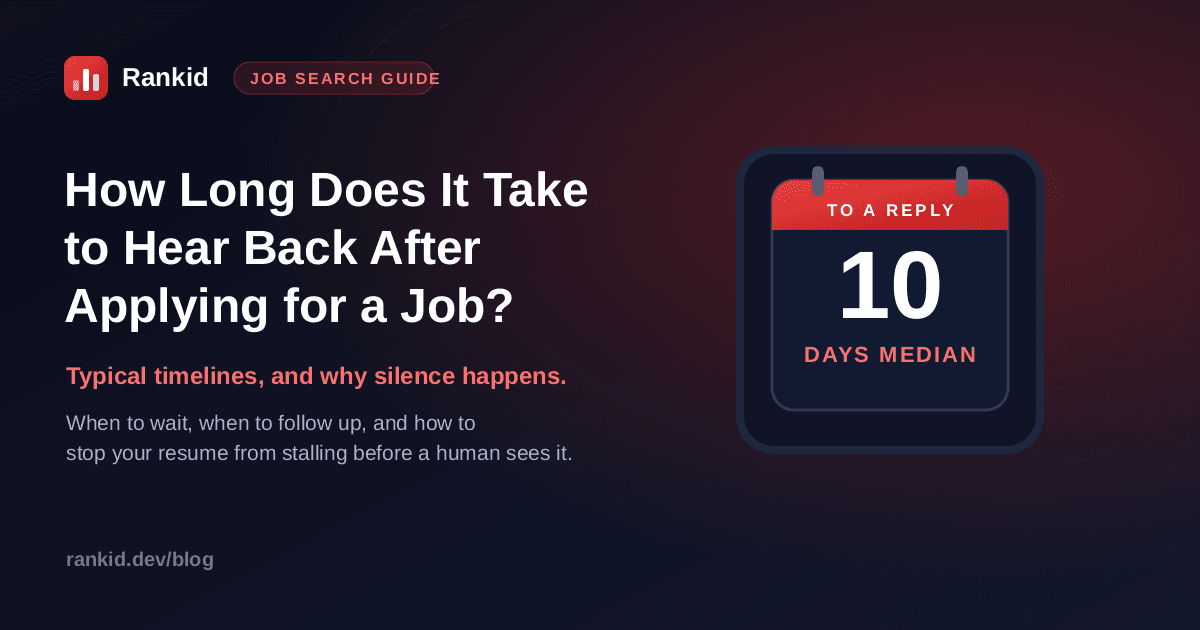
How long does it take to hear back after applying for a job: a calendar showing a median of 10 days to a first reply
Job SearchApplicationsRecruiting

How Long Does It Take to Hear Back After Applying for a Job? (2026 Timeline)

You applied, and now you are refreshing your inbox. So how long does it actually take to hear back after applying for a job? Here are the real response windows, why most applications get no reply at all, exactly when to follow up, and how to keep your resume from dying in the ATS before a recruiter reads it.

Jul 13, 2026 · 11 min read
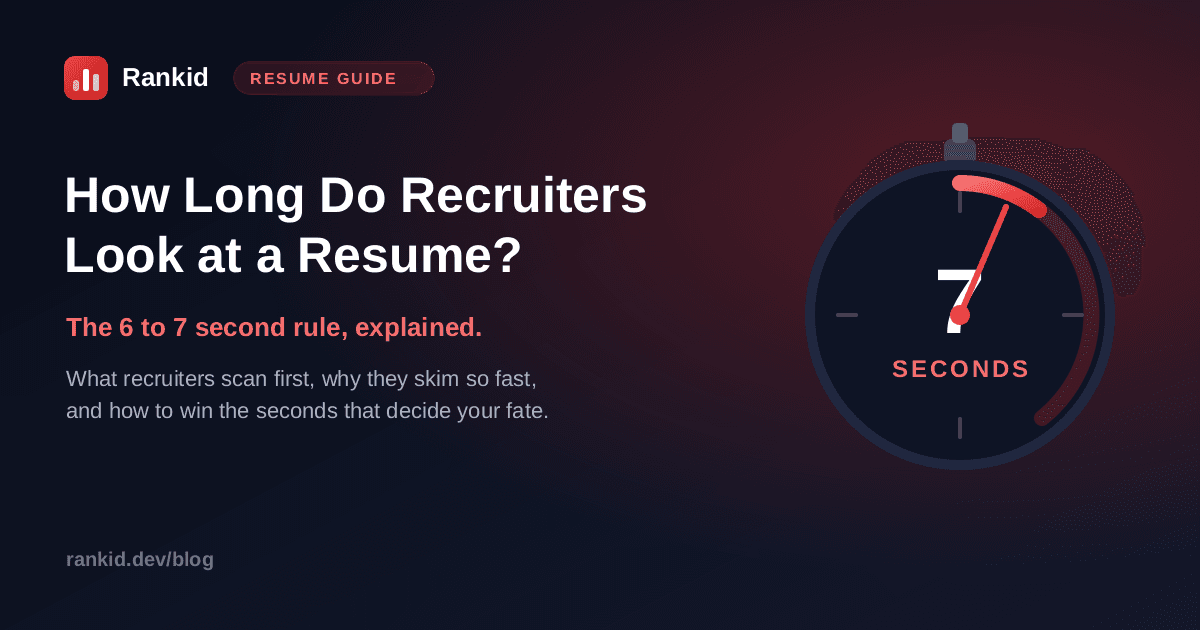
How long do recruiters look at a resume: a stopwatch reading 7 seconds, the average time a recruiter spends scanning a resume on the first pass
Job SearchResumesRecruiting

How Long Do Recruiters Look at a Resume? The 6-Second Rule, Explained (2026)

The famous stat says recruiters look at a resume for 6 to 7 seconds. It is true, but misunderstood. Here is what actually happens in those seconds, the five zones a recruiter scans first, and how to make every one of them count.

Jul 9, 2026 · 10 min read
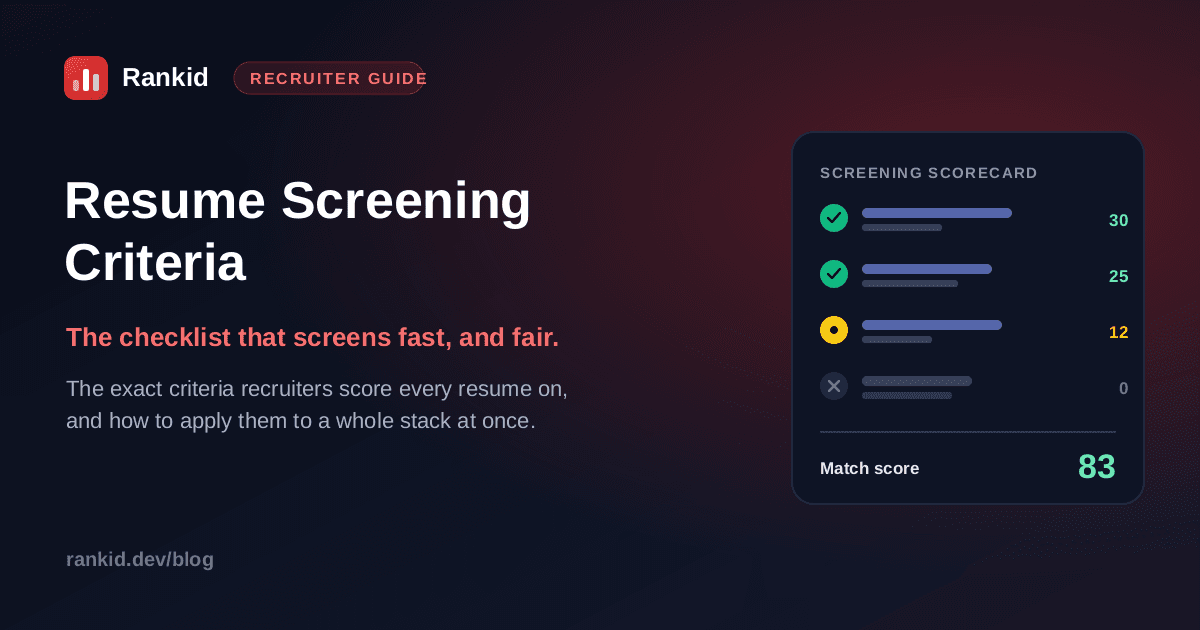
Resume screening criteria: a weighted screening scorecard giving points for must-have skills, keyword match, seniority and experience, totalling a match score of 83
RecruitingHiringATS

Resume Screening Criteria: The Checklist Recruiters Use to Screen Fast in 2026

Screening resumes without fixed criteria is just gut feel with extra steps. Here are the five criteria recruiters actually score resumes on, how to weight them into a checklist, and how to apply that same scorecard to a whole stack at once.

Jul 8, 2026 · 11 min read
Compare resumes to a job description: a matrix showing four candidates matched against the same job requirements side by side, each scored 94, 88, 71 and 63 against one posting
RecruitingHiringATS

How to Compare Multiple Resumes to a Job Description at Once (2026)

You have one job description and a folder full of resumes. Opening them one by one and holding it all in your head does not work. Here is how to compare every resume to the job at once, on the same criteria, and see who fits side by side in minutes.

Jul 7, 2026 · 11 min read

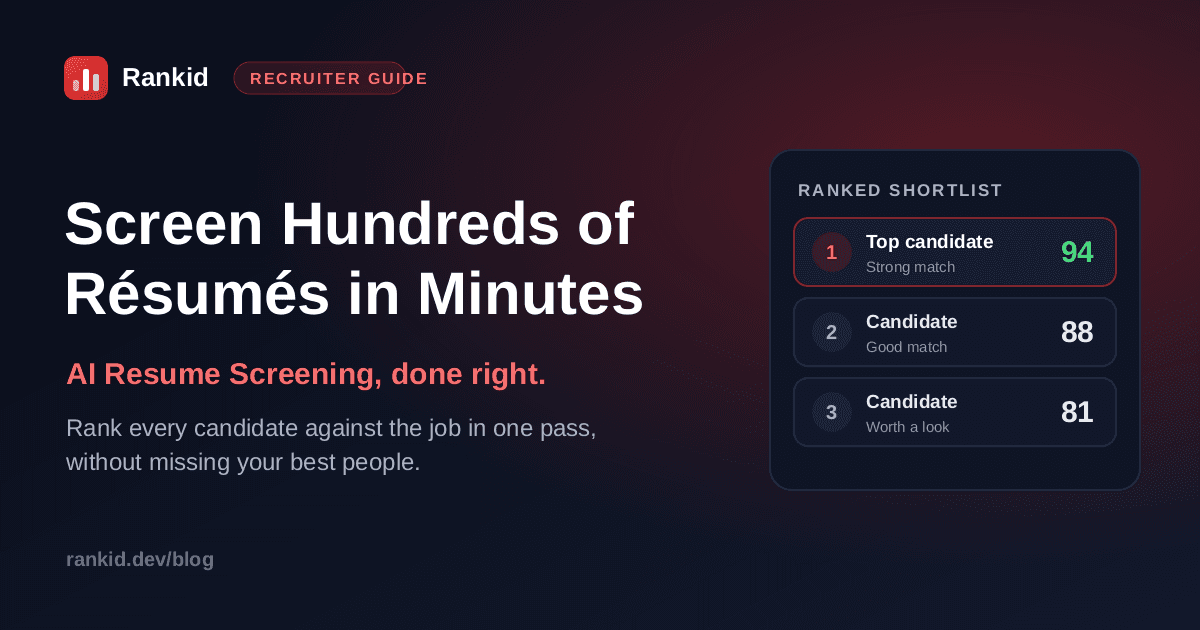
How to shortlist candidates: a recruiter view of 208 resumes screened and scored against one job description, with a dashed shortlist line separating the top matches (94, 89, 83) from the rest
RecruitingHiringATS

How to Shortlist Candidates: From 200 Resumes to a Top 10 in Minutes (2026)

Two hundred applicants, one role, and no time to read them all. Candidate shortlisting is how you cut that pile down to the people worth interviewing, without missing the strong ones. Here is the exact process recruiters use in 2026.
Jul 6, 2026 · 12 min read
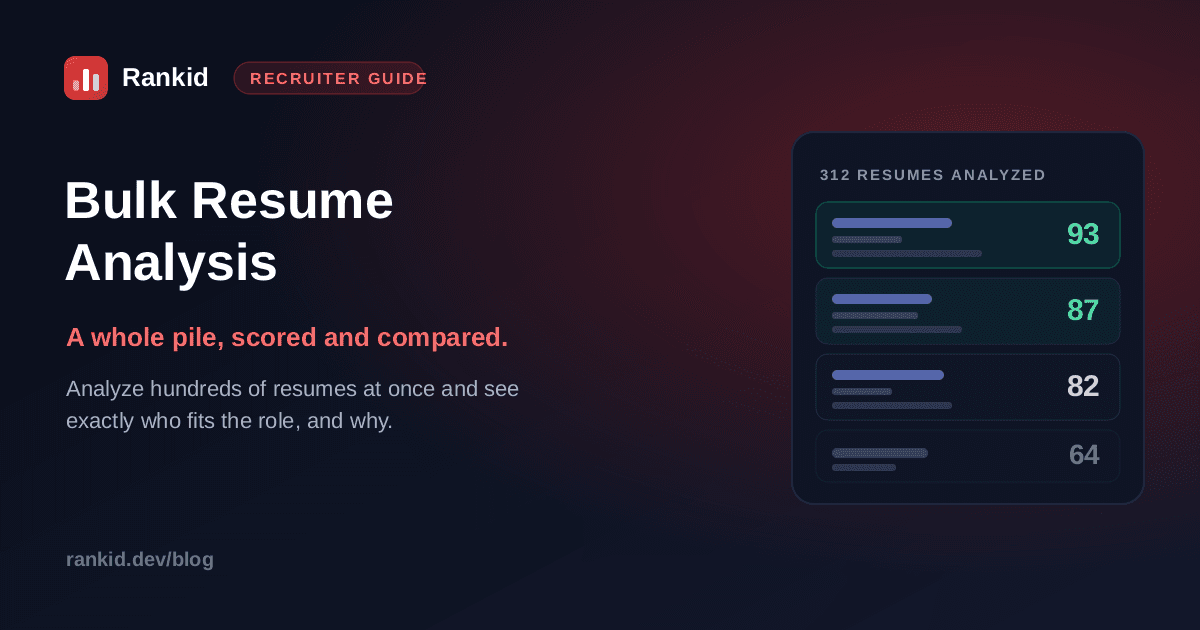
Bulk resume analysis: a recruiter dashboard showing 312 resumes analyzed and scored against one job description, with the top candidates ranked 93, 87 and 82 by fit
RecruitingHiringATS

Bulk Resume Analysis: How Recruiters Analyze Hundreds of Resumes in Minutes (2026)

Reading 300 resumes for one role is impossible. Bulk resume analysis reads them all at once, scores each candidate against the job, and hands you a comparison table of who fits and why. Here is exactly how recruiters do it in 2026.

Jul 5, 2026 · 11 min read

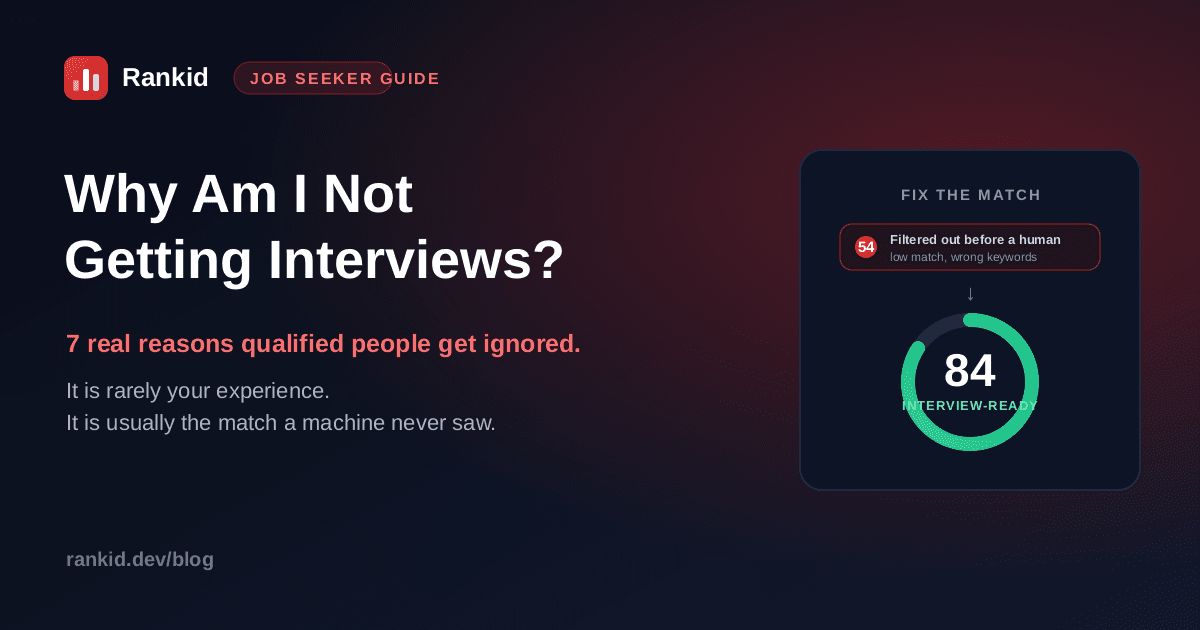
Why am I not getting interviews: a resume filtered out at a 54 match score, then fixed to an interview-ready 84 match score with Rankid
Job SearchResume TipsATS

Why Am I Not Getting Interviews? 7 Real Reasons (and How to Fix Them Fast)

You're qualified, you're applying, and your inbox is silent. It is almost never your experience. It is usually a match a machine scored and rejected before any human read a word. Here are the 7 real reasons you're not getting interviews, and how to fix each one this week.

Jul 3, 2026 · 12 min read

How to use ChatGPT to tailor your resume: a job description and resume feeding into a ChatGPT draft, then verified with a Rankid match score of 88
AI ToolsResume TipsJob Search

How to Use ChatGPT to Tailor Your Resume to a Job Description (2026 Guide + Prompts)

ChatGPT can rewrite your resume for a job in thirty seconds. It can also quietly invent skills, stuff keywords, and hand you something that reads great to you and scores badly with the actual ATS. Here are the exact prompts to use, and how to verify the result before you apply.

Jul 2, 2026 · 11 min read

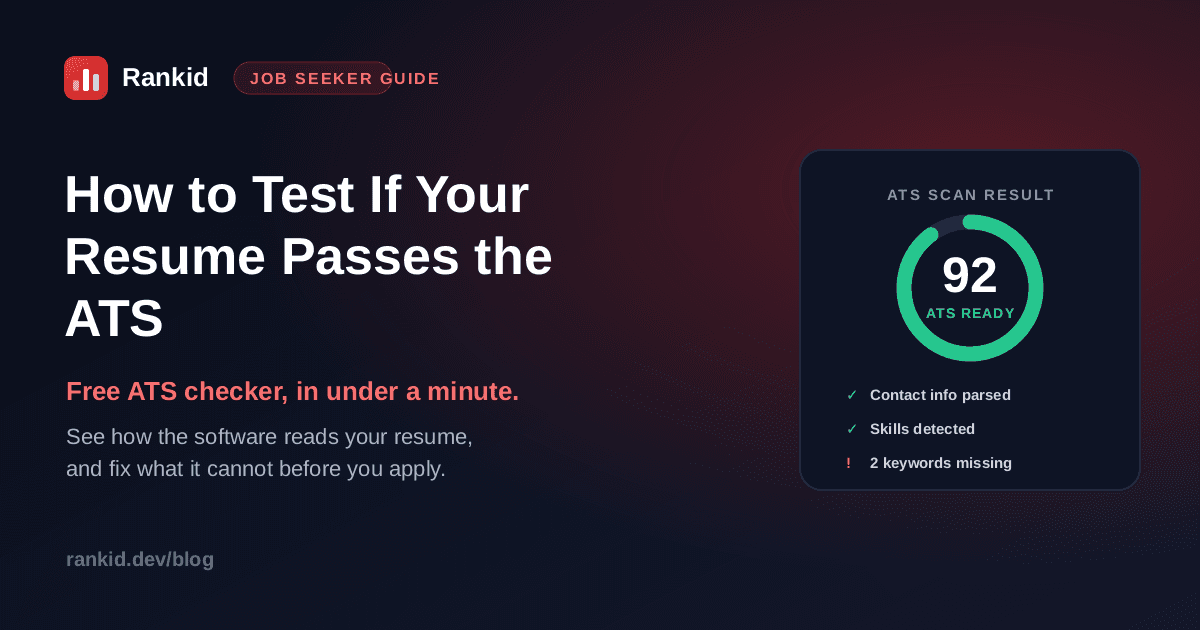
How to test if your resume passes the ATS: an ATS scan result card showing a score of 92, contact info parsed, skills detected, and 2 keywords missing
ATSResume TipsJob Search

How to Test If Your Resume Passes the ATS (Free ATS Checker, 2026)

Most resumes are rejected by software before a person ever sees them. Here is how to test if your resume passes the ATS, using a free checker that shows you exactly what the system can and cannot read, so you can fix it before you apply.

Jul 1, 2026 · 10 min read

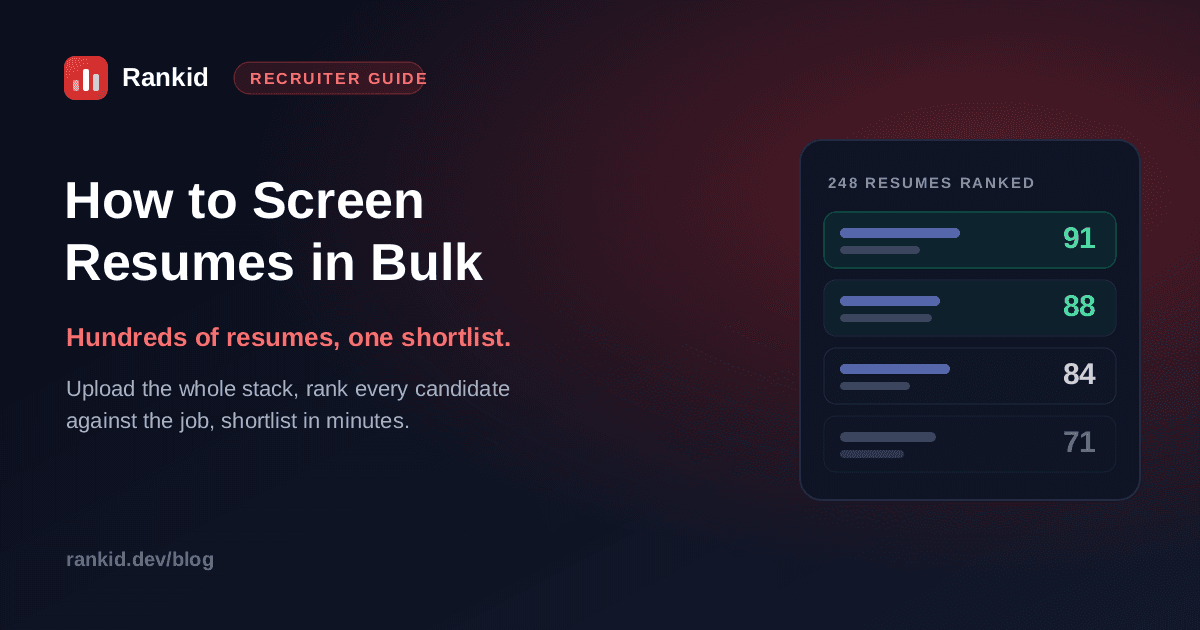
How to screen resumes in bulk: a recruiter dashboard showing 248 resumes uploaded and ranked against one job description, with the top candidates scored 91, 88 and 84
RecruitingATSHiring

How to Screen Resumes in Bulk: A Recruiter's Guide (2026)

When 300 resumes land for one opening, reading them one by one is impossible. Here is how recruiters screen resumes in bulk: upload them all at once, rank every candidate against the job description, and get a shortlist in minutes, not days.

Jun 29, 2026 · 10 min read

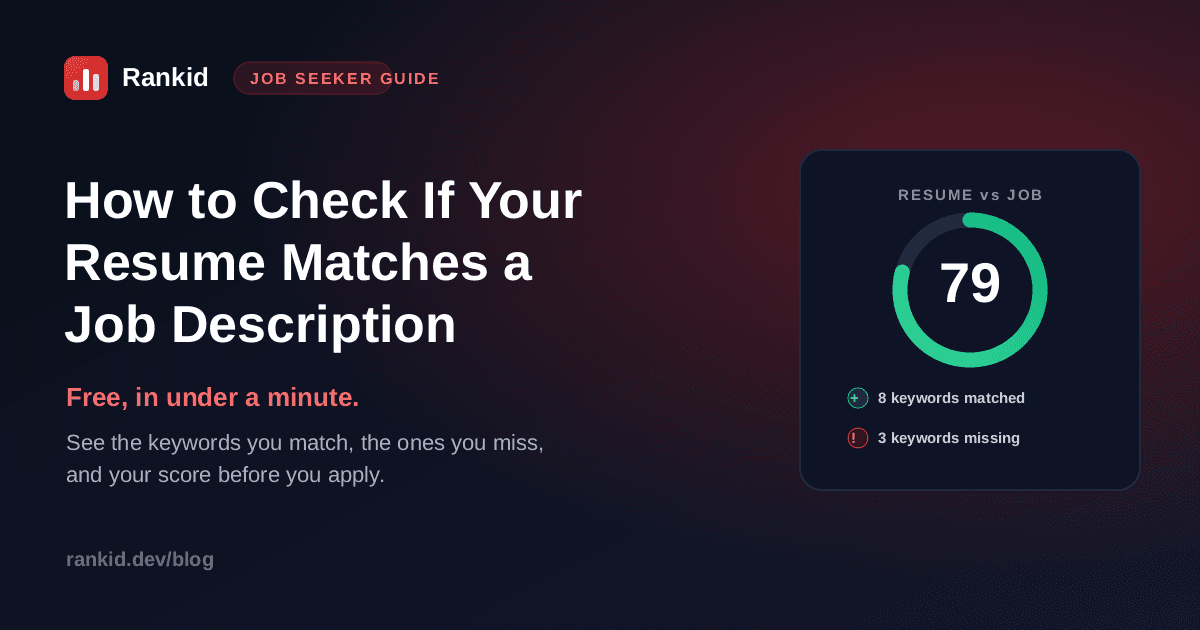
How to check if your resume matches a job description: a resume-versus-job match card showing a score of 79, 8 keywords matched and 3 keywords missing
Resume TipsATSJob Search

How to Check If Your Resume Matches a Job Description (Free, 2026)

Before you hit apply, you can see exactly how well your resume matches the job description, which keywords you cover, and which required ones you are missing. Here is how to check your resume against any job posting in under a minute, free.

Jun 28, 2026 · 9 min read

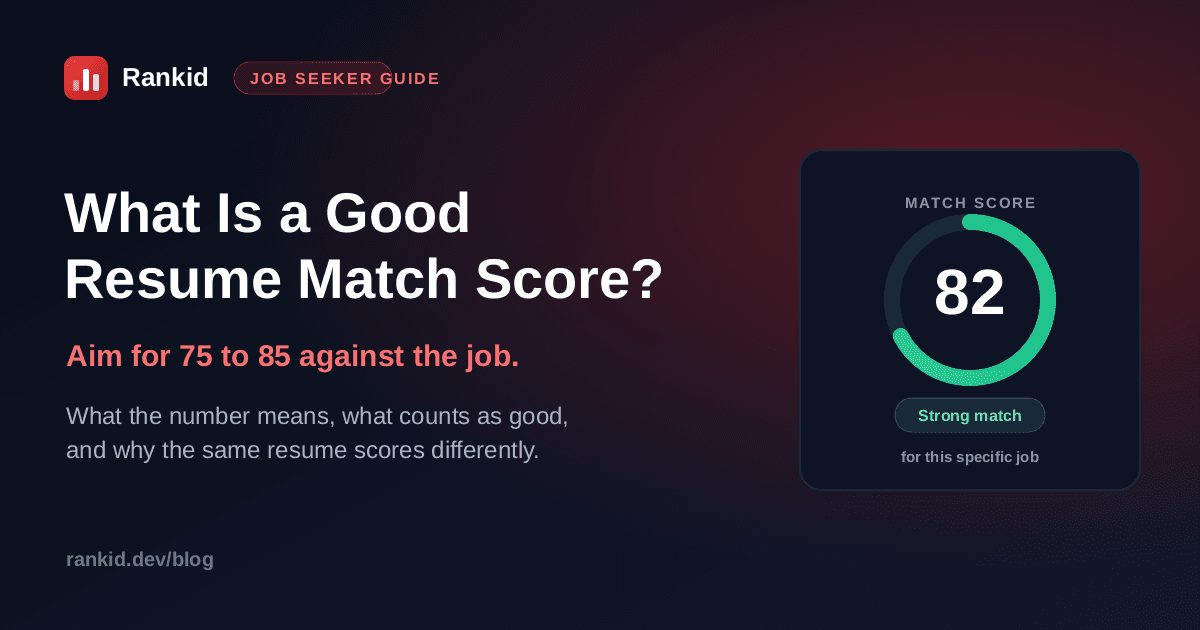
What is a good resume match score: a match score ring reading 82 marked as a strong match for a specific job
Resume TipsATSJob Search

What Is a Good Resume Match Score? ATS Score Ranges Explained (2026)

You ran your resume through a checker and got a number. Is it good? A good resume match score is usually 75 to 85 percent, but the number means nothing until you know what it measures. Here is how to read your score and what to do with it.

Jun 27, 2026 · 9 min read

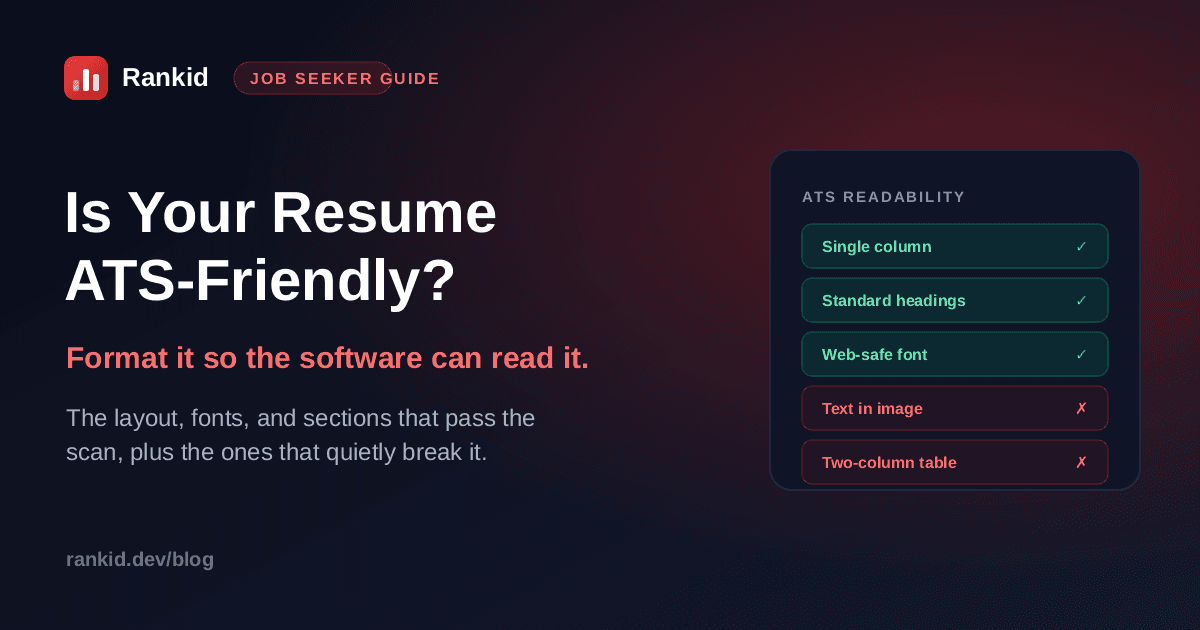
Is your resume ATS-friendly? An ATS readability checklist showing single column, standard headings, and web-safe fonts passing while text-in-image and two-column tables fail
Resume TipsATSJob Search

ATS-Friendly Resume: How to Make One That Actually Gets Read (2026)

Your resume can be perfect and still get filtered if the software cannot read it. Here is exactly what makes a resume ATS-friendly: the format, fonts, and sections that pass the scan, the design choices that quietly break it, and how to check your own before you apply.

Jun 26, 2026 · 10 min read

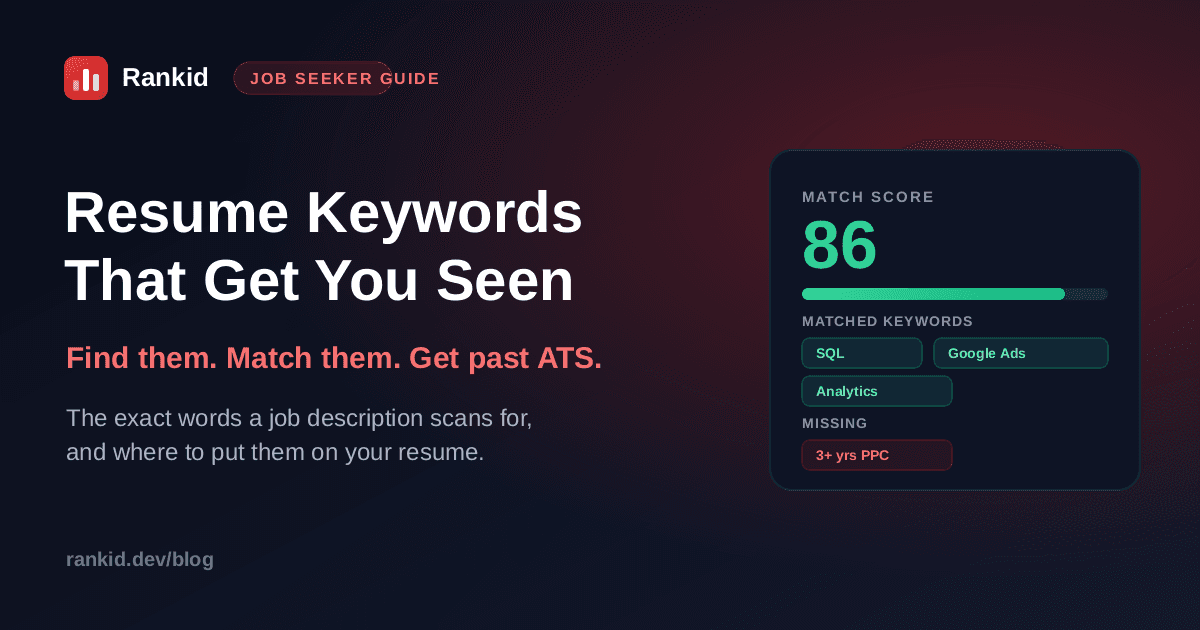
Resume keywords: how to find and use the right keywords to get past ATS
Resume TipsATSJob Search

Resume Keywords: How to Find and Use the Right Ones to Get Past ATS (2026)

The right resume keywords are the difference between getting ranked and getting filtered. Here is how to pull the exact keywords from any job description, place them so an ATS reads them, and check your match before you apply.

Jun 22, 2026 · 9 min read

Why your resume gets auto-rejected by ATS in 7 seconds, and how to fix it
Job SearchATSResume Tips

Why Your Resume Gets Auto-Rejected in 7 Seconds (and the 10-Minute Fix) (2026)

Most resumes are filtered before a human reads them, not on merit but on match. Here's exactly why your resume gets rejected by ATS, and the 10-minute fix to get past the filter and land more interviews.

Jun 20, 2026 · 9 min read

AI resume screening: rank hundreds of resumes against a job description in minutes
RecruitingHiringAI Screening

AI Resume Screening: How to Screen Hundreds of Resumes in Minutes (2026)

A recruiter's playbook for screening hundreds of resumes fast: how AI resume screening works, the 5-step process, and how to rank every candidate against the job in a single bulk pass.

Jun 19, 2026 · 9 min read

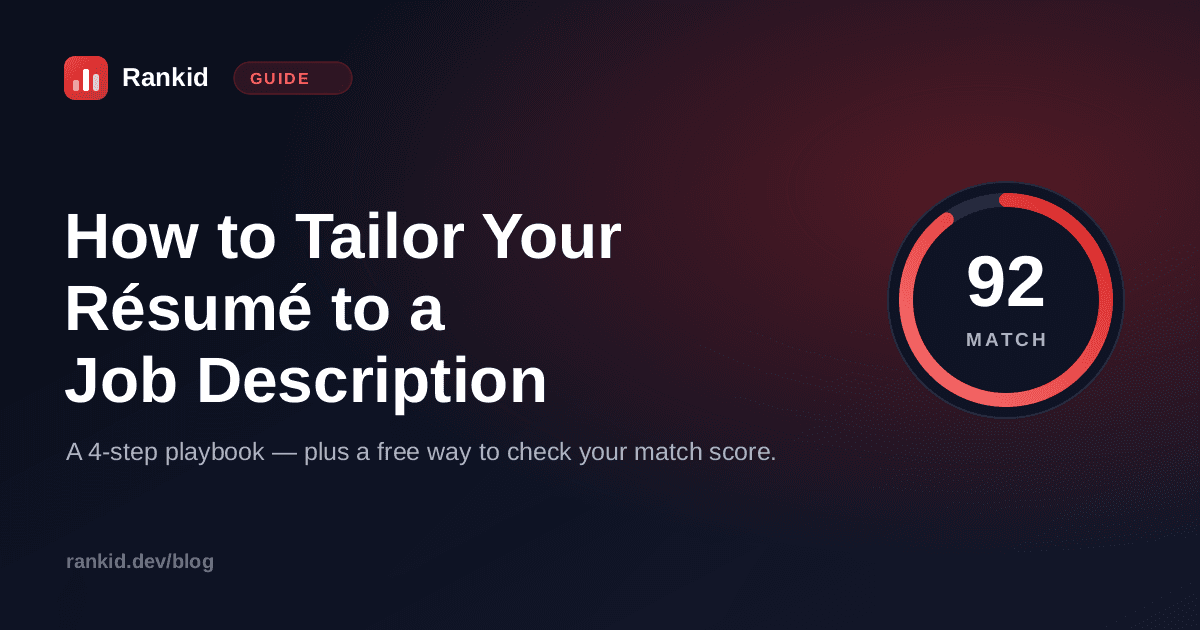
How to tailor your resume to a job description: a 4-step Rankid guide
Job SearchResume TipsATS

How to Tailor Your Resume to a Job Description (2026 Guide)

A practical 4-step playbook for matching your resume to any job description: decode the keywords, mirror the requirements, and check your match score before you apply.

Jun 18, 2026 · 8 min read