What Is a Good Resume Match Score? ATS Score Ranges Explained (2026)
You ran your resume through a checker and it spat out a number. 64. Or maybe 78, or 91. And your very next thought was the only one that matters: is that good? Here is the honest answer, plus the part most tools skip: the number is meaningless until you know what it measures and what each range is actually telling you to do.
Quick answer
What is a resume match score?
A resume match score (sometimes called an ATS score or match rate) is a percentage that shows how closely your resume matches one specific job description. Think of it like a checklist: the posting lists the skills, keywords, job title, and experience it wants, and the software checks how many of those actually appear on your resume. The more boxes you tick, with real evidence, the higher the score.
This is the same comparison an applicant tracking system and a recruiter make when they decide whether you move forward, which is exactly why the number is worth understanding. It is the logic behind AI resume screening and a big part of why qualified resumes get rejected.
It is a job-specific score, not a report card
What is a good resume match score?
Across the major resume tools and career guidance, the consensus lands in a clear band. A score of 75 to 85 percent is good, and 80 percent is the number to aim for. That range is high enough to surface in a recruiter's keyword search and clear the automated screen, while still reading naturally to the human who looks next. You do not need a perfect 100, and chasing one usually backfires.
What each score range means
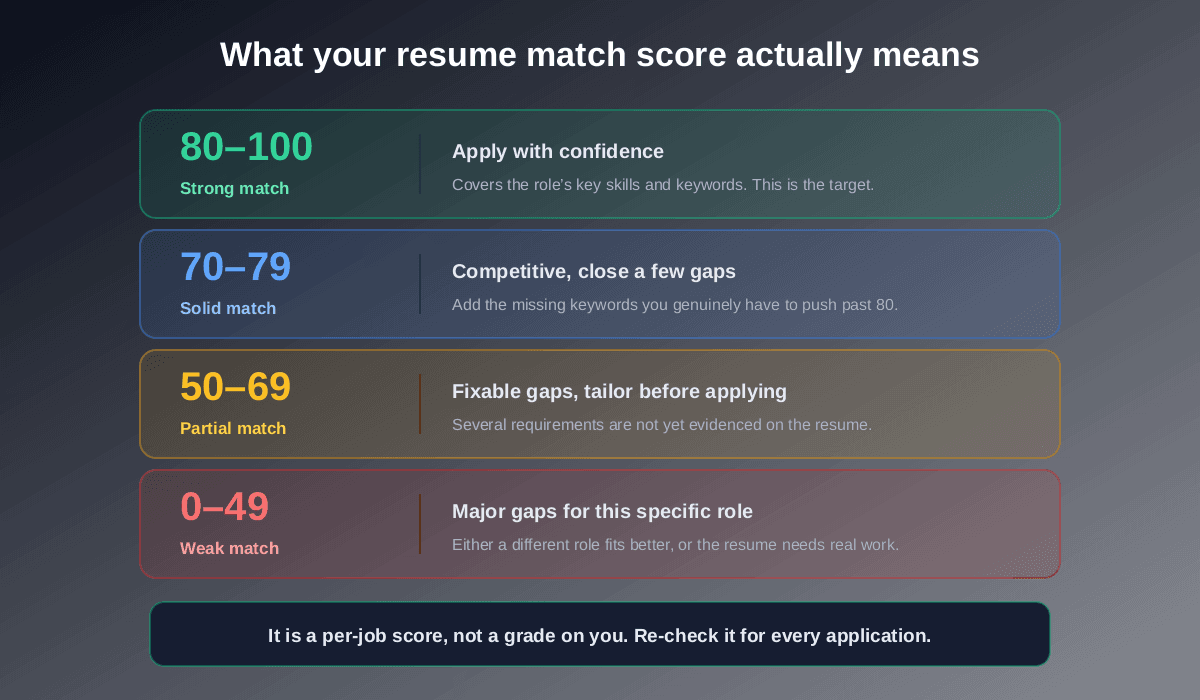
- 80 to 100, strong match.Your resume covers the role's key skills and keywords. Apply with confidence. This is the target.
- 70 to 79, solid match.You are competitive, but a few required terms are missing or buried. Add the genuine skills you have, in the posting's wording, to push past 80.
- 50 to 69, partial match. Several requirements are not yet evidenced on the page. The gaps are usually fixable by tailoring before you apply, not by rewriting from scratch.
- 0 to 49, weak match. Major gaps for this specific role. Either a different job fits your background better, or the resume genuinely needs the skills and keywords this one demands.
Some context worth knowing: industry analyses from tools like Jobscan have reported that resumes scoring around 80 percent or higher tend to earn noticeably more interview callbacks than those well below it. The exact multiplier varies by study, but the direction is consistent: a clear, evidenced match gets seen.
Do not chase 100 by stuffing keywords
Why the same resume scores differently on every job
This is the part that confuses people most. You upload the exact same resume to two jobs and get a 45 on one and an 82 on the other. Nothing is broken. The score measures fit against that posting, and every posting names different required skills, tools, and keywords. A resume that is perfect for one role can be a partial match for another that looks similar on the surface.
The takeaway is simple: there is no single “my resume score.” There is only your score for a particular job, which is why tailoring works and why you should check your match for every serious application. We walk through the tailoring method in how to tailor your resume to a job description.
How to raise a low match score
A low score is not a dead end, it is a to-do list. Here is how to move the number in about ten minutes, honestly.
Find the required keywords you are missing
Read the posting and list the hard skills, tools, certifications, and the job title it treats as requirements. A good checker shows you exactly which of these are missing from your resume, so you are not guessing.
Add the ones you genuinely have, in the same words
For every missing keyword that is actually true of you, mirror the posting's exact wording on your resume. This recovers credit you were losing to a synonym, and it is the single fastest way to lift the score. Never claim a skill you cannot back up.
Back each keyword with evidence
Move your most important terms into the top third of the page and prove them in your experience bullets. A keyword that appears near the top and shows up as a real result reads as a credible match to both software and humans.
Make sure the format is not eating your score
If skills you clearly listed are not being counted, your layout may be scrambling them. Keep it single-column with standard headings, as covered in how to make an ATS-friendly resume.
Re-check and confirm before you apply
Run the resume against the job again and watch the score climb as the gaps close. Apply once you have cleared the bar, instead of hoping you did.
See your resume match score in seconds, free
Paste a job description and upload your resume into Rankid. You'll get a 0 to 100 match score for that exact job, the skills and keywords you've matched, and the required ones you're missing, so you can raise the score before you apply. Your first check is free.
Check your match score freeWhat a good score is not
- It is not a guarantee. A high score clears the filter; it does not promise an interview. The rest of your resume and timing still matter.
- It is not universal.There is no permanent “resume grade.” Each job gets its own score.
- It is not a reason to lie. Inflating the number with skills you do not have only moves the rejection from the screen to the interview.
- It is not the whole story. Aim for a strong, honest match in the 80s, then stop optimizing and apply.
Key takeaways
- A good resume match score is generally 75 to 85 percent, and 80 or above is a strong match.
- The score measures fit against one specific job description, not the overall quality of your resume.
- Below 50 means major gaps, 50 to 69 means fixable gaps, 70 to 79 is competitive, and 80-plus is strong.
- The same resume scores differently on every job, so tailor and re-check for each application.
- Raise a low score by adding genuine missing keywords with evidence, not by stuffing terms you cannot back up.
So, is your number good? If it is in the 80s for the job in front of you, yes, go apply. If it is lower, you now know exactly what the gap is and how to close it. Pull the missing keywords, prove them, and re-check before you submit. Run your next application through Rankid's free resume checker and turn that score into interviews.
Frequently asked questions
What is a good resume match score?
A good resume match score is generally in the 75 to 85 percent range, with 80 percent and above considered a strong match for the job. Below 50 percent signals major gaps for that specific role, 50 to 69 percent means fixable gaps to close before applying, and 70 to 79 percent is competitive but worth tightening. Remember the score is specific to one job description, not a universal grade on your resume.
What does a resume match score actually mean?
A resume match score is a percentage that shows how closely your resume matches one specific job description. The software compares the skills, keywords, job title, and experience the posting asks for against what appears on your resume, like a checklist. A higher percentage means you cover more of what that role requires.
Is a 70 percent resume match score good?
A 70 percent score is a solid, competitive match, but it usually means a few required keywords or skills are missing or not clearly evidenced. It is worth pushing toward 80 percent by adding the genuine skills you have using the same wording as the posting, since that is the range most career tools recommend aiming for.
Why does my resume score differently on different jobs?
Because the score measures fit against one specific job description, not the overall quality of your resume. The exact same resume can score 45 percent for one role and 82 percent for a nearly identical role at another company, because each posting names different required skills, keywords, and experience. That is why you should re-check your match for every job you apply to.
Does a higher match score guarantee an interview?
No tool can guarantee an interview, but a higher match score means your resume clearly covers what the role asks for, so you are far less likely to be filtered out before a human reads it. The goal is to clear the bar with a genuine, evidenced match, not to chase 100 percent by stuffing in keywords you cannot back up.
How do I check my resume match score?
Paste the job description and upload your resume into a match checker like Rankid. You will get a 0 to 100 score for that specific job, the skills and keywords you match, and the required ones you are missing, so you can close the gaps and raise your score before you apply. Your first check is free.