How to Test If Your Resume Passes the ATS (Free ATS Checker, 2026)
You submit a resume you are proud of, and then nothing. No rejection, no interview, just silence. More often than not the reason is not your experience, it is that a piece of software read your resume first and could not make sense of it. Before you send out one more application, it is worth sixty seconds to answer one question: will your resume actually pass the ATS? The good news is you can test it yourself, the same way the system will.
Quick answer
What an ATS is, and why it decides your fate first
An applicant tracking system, or ATS, is the software almost every employer uses to collect and organize job applications. When you apply online, your resume goes into the ATS first, where it is parsed into plain text, sorted into fields like name, skills, and work history, and then scored and ranked against the job requirements. Recruiters search and filter that database using keywords pulled straight from the posting.
The catch is simple: the system can only rank what it can read. If your layout scrambles the text or your resume is missing the terms the role calls for, you sink to the bottom of the pile before a human ever opens it. That is a big part of why qualified resumes get rejected, and it is exactly what a quick test lets you catch in advance.
Passing the ATS is two things, not one
How to test if your resume passes the ATS
The fastest, most reliable way is to run your resume through a checker that reads it the way an ATS does, then tells you what it saw. Here is the full process, start to finish, in under a minute.
Upload the exact file you plan to send
Use the same PDF or .docx you intend to submit, not a cleaned-up version. The checker reads it the way an applicant tracking system would, so if your layout is scrambling the text, you want to see that on the real file. This is the parse test: it reveals whether your contact details, section headings, and skills are being read at all.
Paste the job description you are targeting
Add the full posting, not just the bullet list. The skills, tools, job title, and years of experience it names are the requirements you will be scored against. This turns a generic format check into a real test of whether your resume matches this specific role, which is what an ATS actually ranks on.
Read your ATS result and missing keywords
You get a clear picture: whether your resume parsed cleanly, a 0 to 100 match score for that job, the skills and keywords you already cover, and the required ones that are missing or not clearly evidenced. That missing list is the most valuable part, because it is your exact to-do list with no guessing.
Fix the gaps, then re-test
Repair anything the parse flagged, add the genuine keywords you were missing using the posting's exact wording, then run the test again and watch the result improve. Apply once you have cleared the bar, not while you are hoping you have.
Test whether your resume passes the ATS, free
Upload your resume and paste the job posting into Rankid. You'll see whether it parses cleanly, your 0 to 100 match score for that exact job, and the required keywords you're missing, so you can fix it before you apply. Your first check is free, no signup needed.
Test your resume freeWhat an ATS test actually checks
When you test your resume, a good checker is looking at the same things the real system does. There are two layers.
The parse layer, which is about whether the software can read your resume at all:
- Contact details. Whether your name, email, and phone are detected as contact fields rather than lost in a header or image.
- Section structure. Whether standard headings like Experience, Education, and Skills are recognized so your content lands in the right fields.
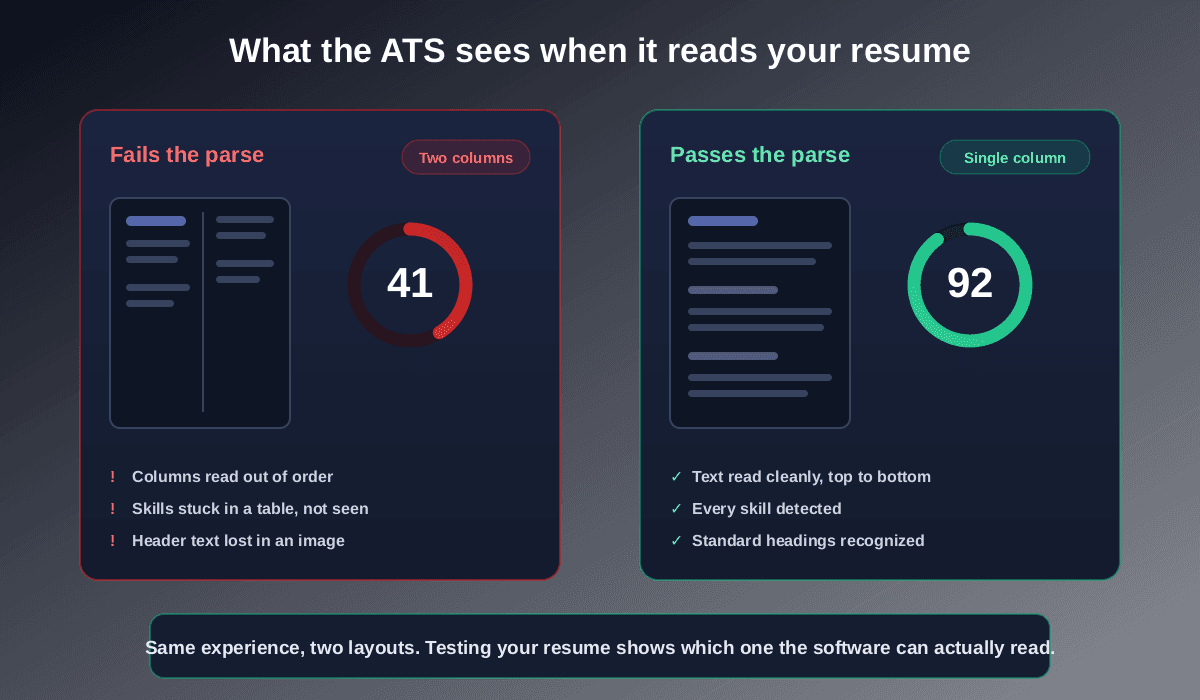
- Reading order. Whether the text flows top to bottom, or a multi-column layout causes the ATS to read your lines out of sequence.
- Real, selectable text. Whether your words are actual text, not pixels inside a graphic or scanned image that the parser sees as blank.
The match layer, which is about whether your content fits the specific job:
- Hard skills and tools. The technologies, software, methods, and certifications named in the posting, matched against what appears on your resume.
- Keywords and phrasing. Whether you use the same wording the posting does. This is covered in depth in our resume keywords guide.
- Job title and experience. Whether your titles, level, and years of relevant experience line up with what the role expects.
For the full picture of how the ranking itself works, see our guide to AI resume screening, and for the number at the end, read what a good resume match score is.
Why resumes fail the ATS, and how to fix each one
Nearly every failed ATS test comes down to a handful of causes. Once a checker points to the exact one, the fix is usually quick and honest:
- Multi-column or table layouts. Fancy two-column templates read out of order or hide skills inside tables. Switch to a single-column layout with real text.
- Text trapped in images or headers. A name or contact block saved as a graphic, or key details in the page header, often parses as blank. Put important text in the body as selectable text.
- Non-standard section headings.Creative labels like “Where I've Made an Impact” confuse the parser. Use plain headings: Experience, Education, Skills.
- Missing keywords.The skill is real but phrased differently, or not on the page at all. Mirror the posting's exact wording for skills you genuinely have.
- Wrong file type. When in doubt, submit a text-based PDF or .docx, and avoid image-only PDFs exported from design tools.
The full formatting playbook, from margins to fonts to file type, is in how to make an ATS-friendly resume.
Add only what is true
Can you test it manually?
You can get a rough sense on your own, and it is a useful habit. Try this: open your resume, select all, copy it, and paste it into a plain text document. If the result comes out in a jumbled order, drops your name, or turns sections into gibberish, an ATS will struggle with it too. Then highlight every hard skill and repeated phrase in the job posting and check that each genuine one appears on your resume.
The limit of the manual method is that it cannot score your match or catch subtler parsing issues, and it will not tell you how close you are to the bar for a specific job. That is why pairing a quick manual read with an automated test works best. It is also closely related to checking how your resume matches a job description, which is the match side of the same test.
How to raise a failing ATS result fast
A failing result is not a verdict, it is a checklist. Most resumes clear the bar with a few honest, targeted edits:
- Fix the format first. Single column, standard headings, real text. If the parse is broken, no keyword will save you.
- Mirror the exact wording.If you have the skill but phrased it differently, match the posting's wording and you instantly recover lost credit.
- Move key terms to the top third. A skills summary near the top, backed by the same terms proven in your experience, reads as a stronger match to software and humans alike.
- Tailor, do not rewrite. You are adjusting emphasis for this posting, not starting over. The full method is in how to tailor your resume to a job description.
Key takeaways
- To test your resume, upload it into a free checker like Rankid, ideally with the job description.
- Passing the ATS means two things: your resume parses cleanly and it matches the job's keywords.
- Common failures are multi-column layouts, text in images, odd headings, and missing keywords, all quick to fix.
- Aim for clean parsing plus a match of 80 percent or higher on each specific job.
- Re-test after every fix, and lightly tailor for each application, since the keyword match changes per job.
Bottom line: never apply blind. Take a minute to test whether your resume passes the ATS, fix the exact issues the report hands you, and apply knowing the software can read you and the recruiter can find you. Run your next application through Rankid's free resume checker and turn silence into interviews.
Frequently asked questions
How do I test if my resume passes the ATS?
Upload your resume into a free ATS checker like Rankid, ideally alongside the job description you are targeting. It reads your resume the same way an applicant tracking system does, then shows you whether your contact details, skills, and sections were parsed correctly, your keyword match against the job, and anything the software could not read. The test takes under a minute and your first check is free.
Is there a free way to check if my resume is ATS friendly?
Yes. Rankid lets you test your resume against the ATS for free, with no signup needed for your first check. You upload your resume, optionally paste the job posting, and instantly see whether it parses cleanly, which skills and keywords are detected, and which required ones are missing for that specific role.
What does it mean if my resume does not pass the ATS?
It usually means the applicant tracking system could not read part of your resume, so the information never reached the recruiter. The common causes are a multi-column or table-based layout, text saved inside an image or header, non-standard section headings, or missing keywords from the job description. Almost all of these are quick to fix once a checker shows you exactly where the parse broke.
Do ATS systems actually reject resumes automatically?
Applicant tracking systems rarely auto-delete a resume, but they rank and filter every application by how well it matches the job, and they can only rank what they successfully read. If your resume parses poorly or lacks the required keywords, it lands at the bottom of the pile where recruiters seldom look, which in practice is the same as being rejected.
What ATS score is considered good?
There is no single universal ATS score, but when you test your resume against a specific job you should aim for a match of around 80 percent or higher, with clean parsing of every section. A high parse rate with a strong keyword match against that exact posting is the real target, not a perfect 100.
Should I test my resume for every job I apply to?
Yes. Parsing is a one-time format check, but the keyword match changes with every posting because each job names different required skills. Running a quick ATS test and lightly tailoring your resume for each serious application is the single highest-leverage way to get past the automated screen and in front of a recruiter.